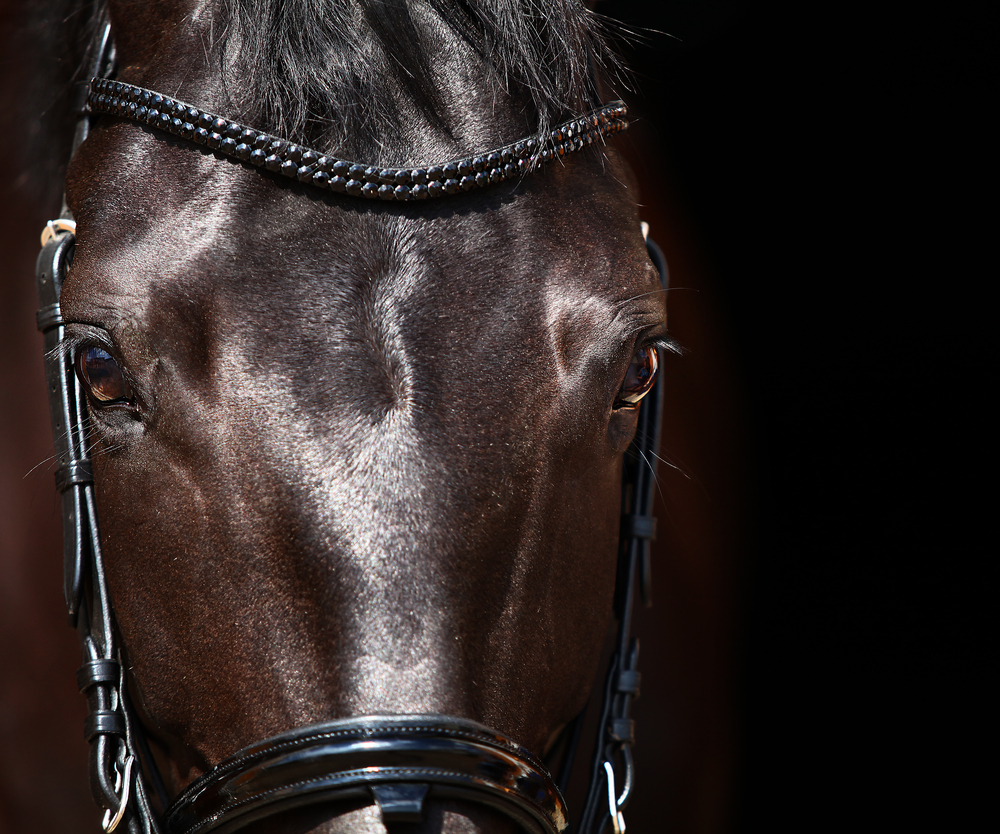
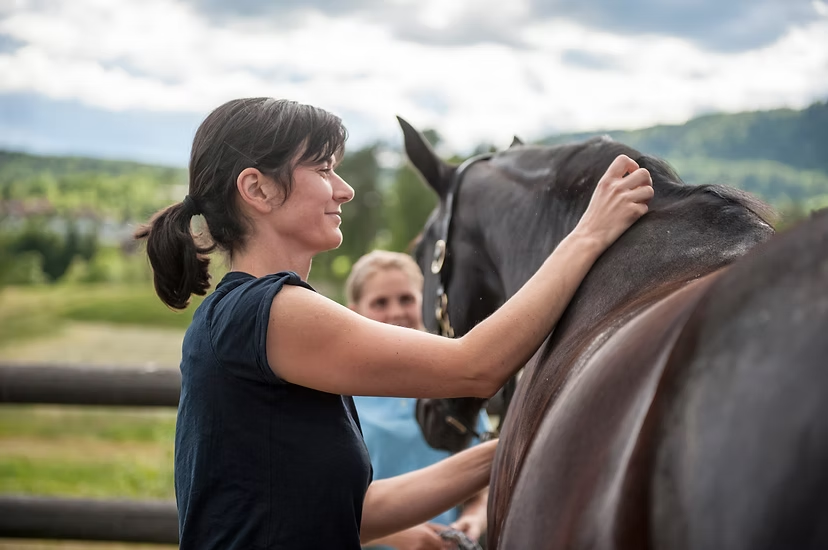
Dr. Manja Baunack working with a horse.

About me

About the practitioner

The path from horse-mad child to equine veterinarian and acupuncture practitioner.

Overview

A short overview of how a life with horses became a profession – from early riding years and veterinary training to research, acupuncture and my own equine practice.

Personal and professional background

I was born in 1982 in Jena, Germany. After studying veterinary medicine in Leipzig I first worked in the university equine clinic and later in a research group for anaesthesiology and intensive care. In 2014 I moved to Norway together with my family and my warmblood mare Mia Luna. As both a veterinarian and horse owner I know everyday life with horses from the inside – from muddy paddocks and late-night checks to competition preparations.

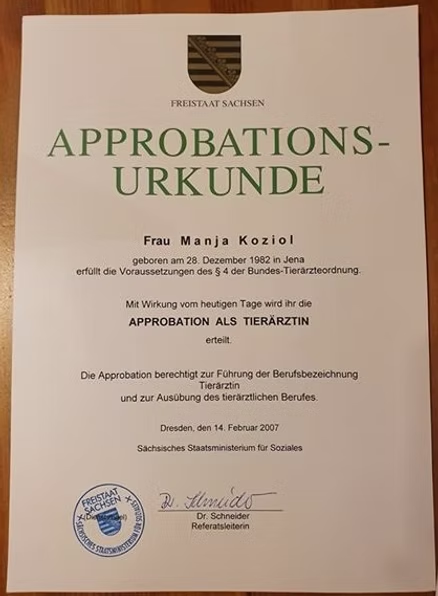
Veterinarian (University of Leipzig, 2007)
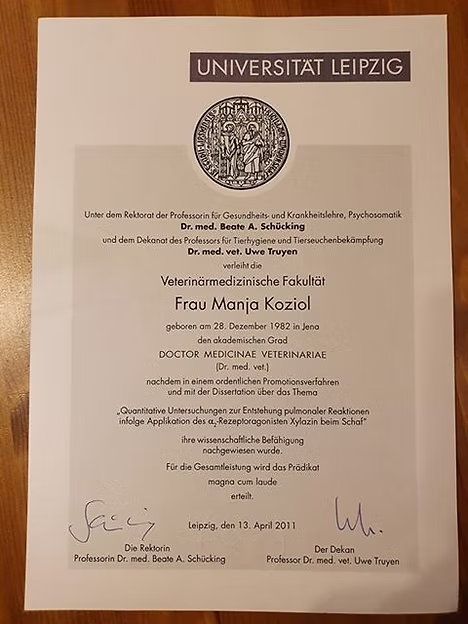
Doctorate in veterinary anaesthesiology & intensive care, 2011
Further training in veterinary acupuncture (ATF-certified), equine acupuncture practice since 2013
Own equine acupuncture practice in Lommedalen, Norway since 2016
Dr. Manja Baunack working with a horse.

Training and professional path

  1. 2007

    Graduated as a veterinarian from the University of Leipzig. Position at the university equine clinic with responsibility for anaesthesia, assistance in surgery and emergency duty.

  2. 2008–2011

    Research work at the University Hospital Leipzig, Clinic for Anaesthesiology and Intensive Care. Collaborative projects between human and veterinary medicine on anaesthesia-related questions. Doctorate completed in 2011.

  3. 2013

    Completed further training in veterinary acupuncture (ATF-certified) and started an equine acupuncture practice in Germany.

  4. 2014

    Moved to Norway with my husband, our twin boys and my warmblood mare Mia Luna.

  5. 2016

    Opened my own equine acupuncture practice in Lommedalen after getting to know the language, routines and horse community in Norway.

Why horses

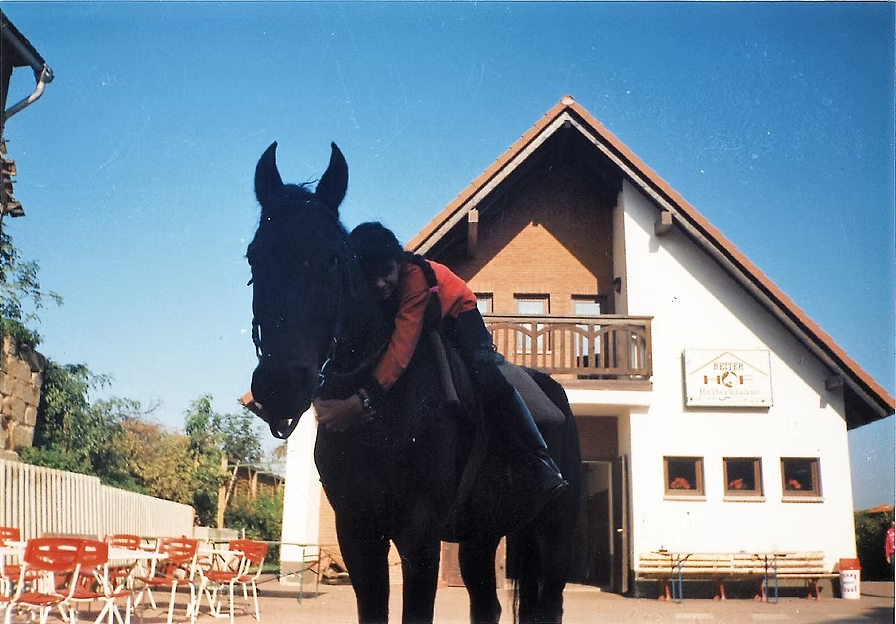
Horses and riding have been my passion since childhood – I started riding at the age of six and grew up as a classic “horse girl”. Studying veterinary medicine allowed me to specialise in horses and to combine science with daily work in the stable. A solid understanding of anatomy and physiology is essential for assessing whether a horse is being trained in a way its body can cope with. This perspective shapes how I look at movement, posture and muscle development in every patient.
Why acupuncture

While working in an equine surgical clinic in Germany I first saw acupuncture used for severe colic pain and after orthopaedic surgery. The relief in the horses was unforgettable. Since then I have often seen how acupuncture can complement conventional medicine – especially in chronic conditions, functional problems and situations where psychological stress plays a role. For me it is not an alternative to veterinary medicine, but a powerful tool that helps the body activate its own regulatory and self-healing mechanisms.

Dr. Manja Baunack working with a horse.

Publications and talks

A selection of lectures and written work – from seminars for riders and therapists to scientific papers produced in collaboration with the University Hospital in Leipzig.

  • September 2017: Lecture “The horse as a four-legged physiotherapist” at a riding physiotherapy seminar (EKT riding school and animal park, Oslo).

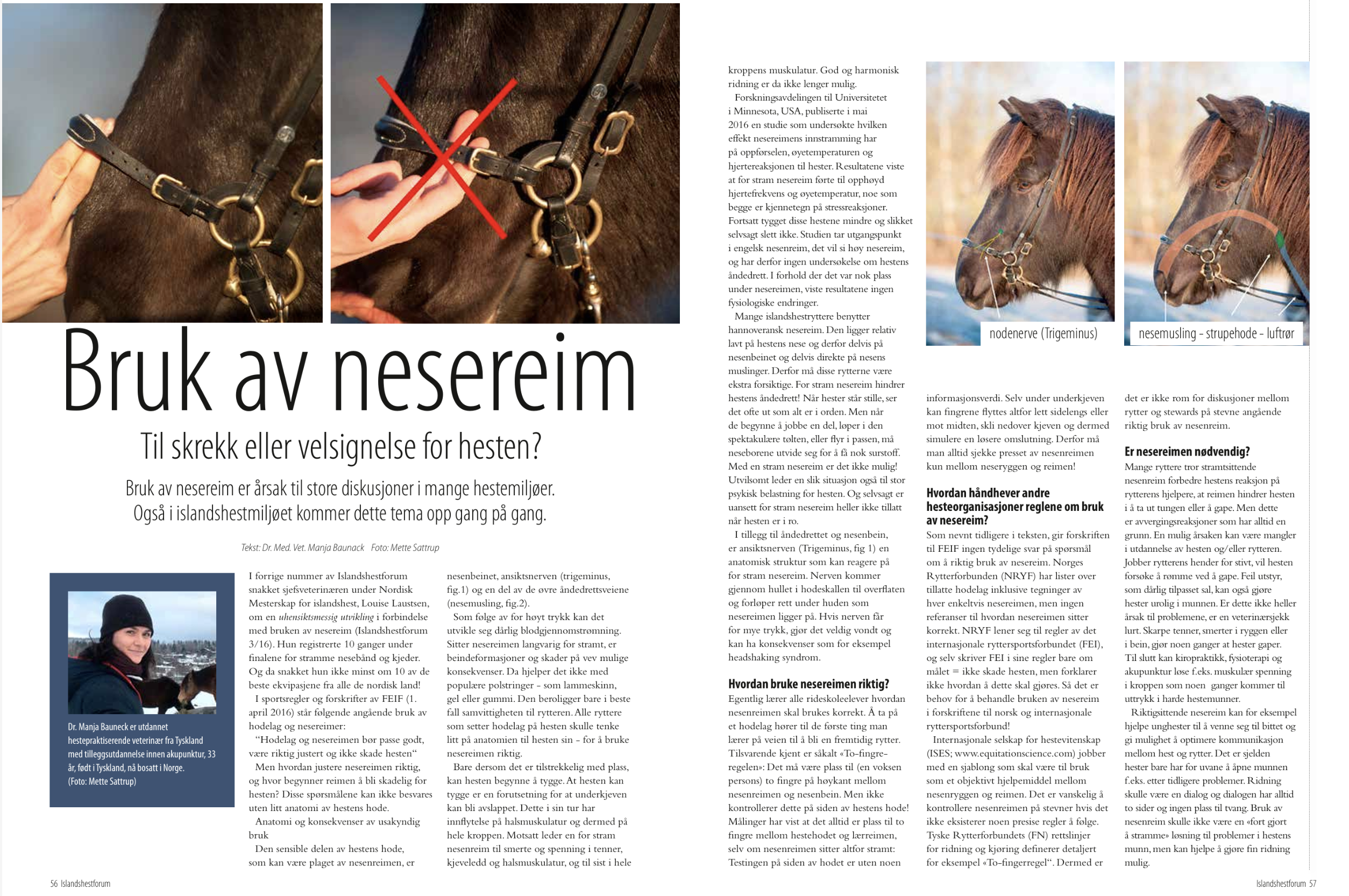
  • December 2016: Article on the use of nosebands in the journal Islandshestforum no. 5/2016.

    Download the noseband article (PDF)
  • November 2016: Lecture “The horse in winter” at the facilities of Lommedalen driving and riding club.

  • Scientific publications in cooperation with the research group at the University Hospital Leipzig, Clinic and Polyclinic for Anaesthesiology and Intensive Care (UKL):

  • Co-author of a study on mesenchymal stem cells and haemodynamic dysfunction after extended liver resection in a pig model (Sci Rep 2017).

  • Contribution to work on lung-protective ventilation concepts after experimental thoracic trauma in pigs, presented at the German Anaesthesiology Congress 2014 (Leipzig).

  • Doctoral thesis on pulmonary reactions after administration of the α2-agonist xylazine in sheep (Leipzig 2011).

  • Co-author of a CT-based validation study on the analysis of lung aeration (Critical Care 2011).

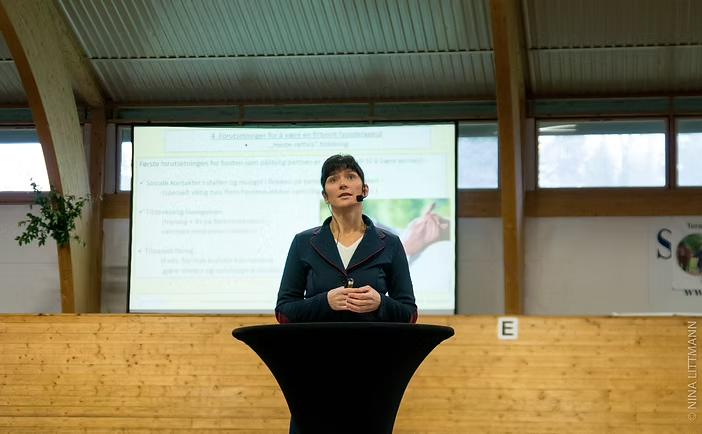
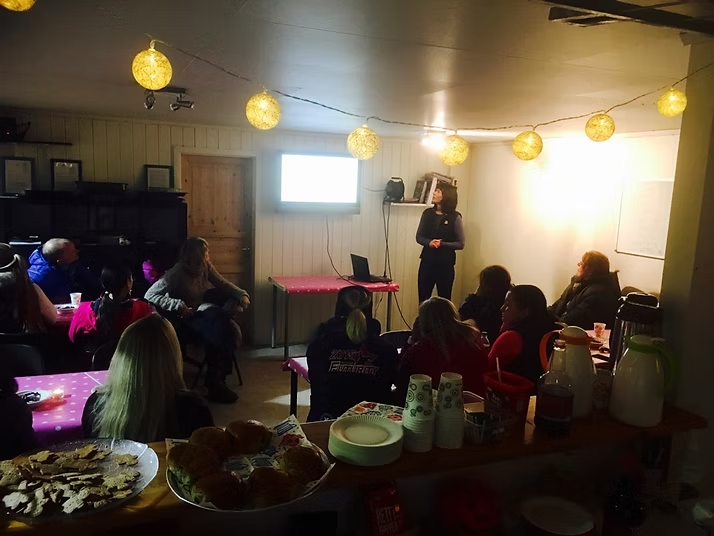
Giving a presentation on horses as “four-legged physiotherapists”.
September 2017 – Oslo: Lecture “The horse as a four-legged physiotherapist” at a riding physiotherapy seminar (EKT riding school and animal park).
Lecture evening on “the horse in winter”.
November 2016 – Lommedalen: Lecture “The horse in winter” at the facilities of Lommedalen driving and riding club.
Magazine spread about noseband use in horses.

December 2016 – Islandshestforum: Article on the use of nosebands in the Icelandic horse journal, issue 5/2016.

Download the noseband article (PDF)

Authorisation

Veterinary authorisation certificate.

Doctorate

Doctorate certificate from the University of Leipzig.